

分享兴趣,传播快乐,
增长见闻,留下美好。
亲爱的您,这里是LearingYard学苑!
今天小编为您带来文章
“喆学(197):精读博士论文
《软件平台系统的治理策略与第三方开发商的接入决策研究》
文献综述(1)”
欢迎您的访问!
Share interest, spread happiness,
increase knowledge, and leave beautiful.
Dear, this is the LearingYard Academy!
Today, the editor brings the
“Zhexue (197): Intensive reading of doctoral thesis
“Research on the Governance Strategy of Software Platform Systems
and the Access Decisions of Third-Party Developers”
Literature review (1)”
Welcome to visit!
本期推文将从思维导图、精读内容、知识补充三个方面介绍精读博士论文《软件平台系统的治理策略与第三方开发商的接入决策研究》文献综述。
This post will introduce a literature review of the doctoral dissertation “Research on Governance Strategies of Software Platform Systems and Access Decisions of Third-Party Developers” from three aspects: mind map, in-depth reading content, and knowledge supplement.
一、思维导图(Mind Maps)
二、精读内容(Intensive reading content)
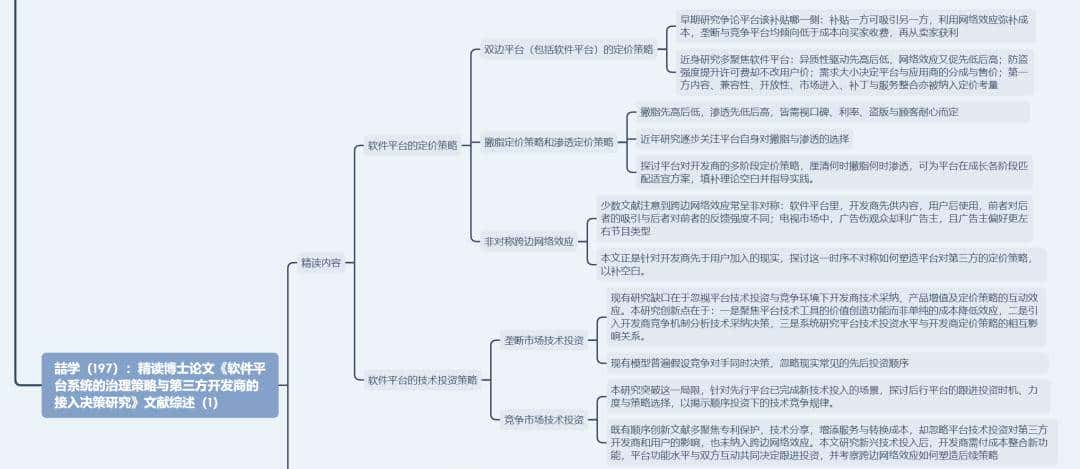
平台治理分价格与非价格两类:前者聚焦用户与开发商,后者重在技术投入、准入规则与伙伴关系。价格是基础,技术投资等非价格策略方保创新长青与生态繁荣。
Platform governance can be divided into two categories: price-based and non-price-based. The former focuses on users and developers, while the latter emphasizes technological investment, access rules, and partnerships. Price is the foundation, while non-price strategies such as technological investment are essential for long-term innovation and a thriving ecosystem.

(1)软件平台的定价策略(Pricing Strategies of Software Platforms)
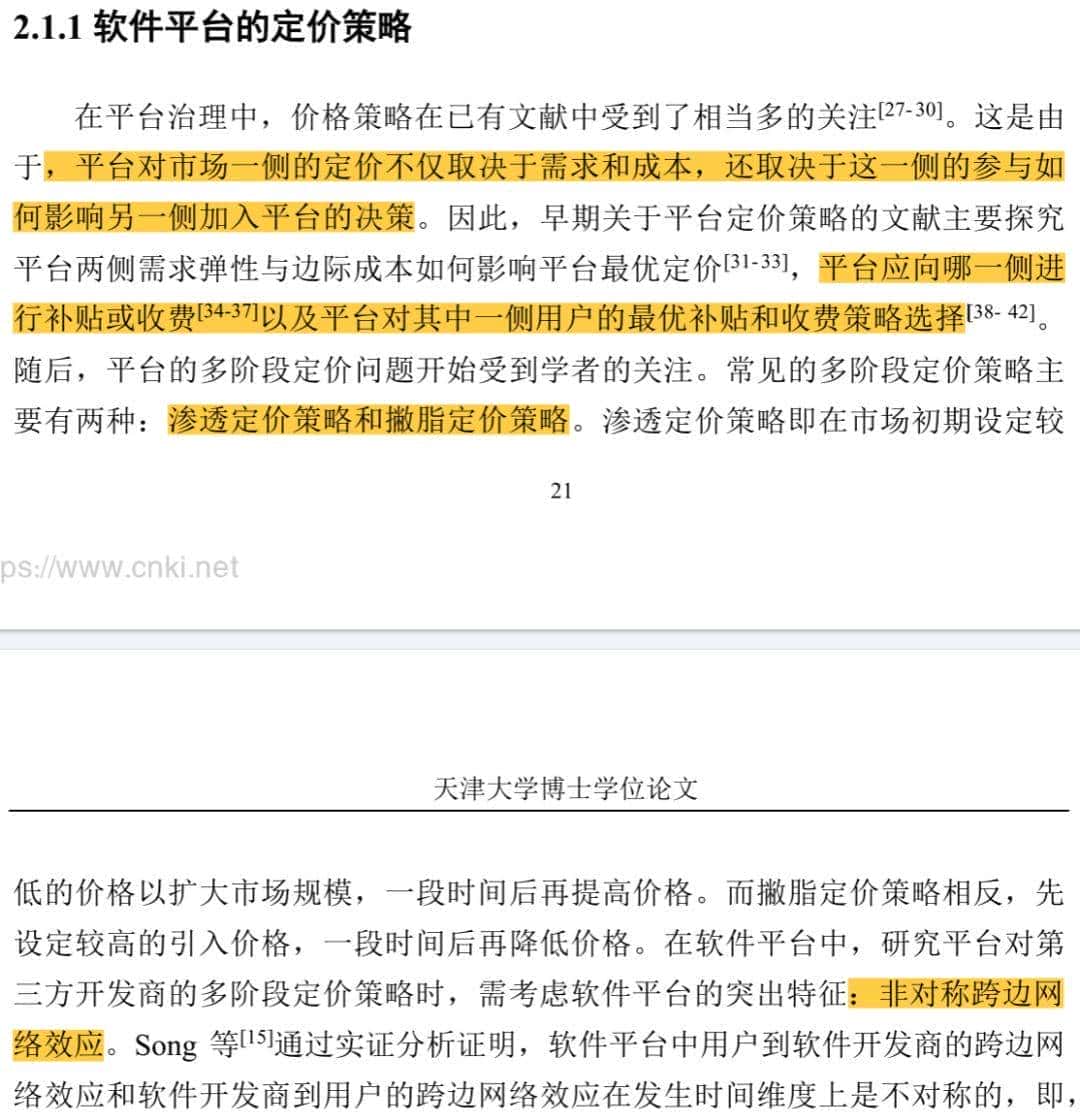
平台价格策略研究先聚焦两侧需求弹性与边际成本,再讨论补贴谁收费谁;继而引入多阶段:渗透以低价抢市后提价,撇脂先高后低。软件平台因开发商到用户的跨边影响立现,用户到开发商却延迟,呈现非对称跨边网络效应,故对开发商的多阶段定价须顾及这一时间差,方能平衡生态与收益。
The research on platform pricing strategies first focuses on the elasticity of demand and marginal cost on both sides, then discusses who subsidizes whom and who charges whom; subsequently, it introduces a multi-stage approach: penetration by grabbing market share with low prices followed by price increases, and skimming by starting high and then lowering prices. Software platforms exhibit an asymmetric cross-side network effect due to the immediate cross-side impact from developers to users, while the impact from users to developers is delayed. Therefore, multi-stage pricing for developers must take this time lag into account in order to balance the ecosystem and revenue.
1.双边平台(包括软件平台)的定价策略(Pricing Strategies of Two-Sided Platforms (Including Software Platforms))
早期研究争论平台该补贴哪一侧:补贴一方可吸引另一方,利用网络效应弥补成本,垄断与竞争平台均倾向低于成本向买家收费,再从卖家获利。新近文献细化最优定价:用户规模小且内容成本高时,用户生成内容平台宜补贴创作者;共享平台随产品价或使用时长上调出借费、下调借入费;网约车最优价由基础、拥堵与应急费用组成;若消费者获补贴,搭便车行为会激化平台价格竞争。
Early research debated which side of the platform should subsidize: subsidizing one side could attract the other, leveraging network effects to offset costs; both monopolistic and competitive platforms tended to charge buyers below cost and then profit from sellers. Recent literature refines optimal pricing: when user-generated content platforms have a small user base and high content costs, they should subsidize creators; sharing platforms should increase lending fees and decrease borrowing fees based on product price or usage duration; the optimal price for ride-hailing services consists of basic, congestion, and emergency fees; if consumers receive subsidies, free-riding behavior will intensify price competition among platforms.

近身研究多聚焦软件平台:异质性驱动先高后低,网络效应又促先低后高;防盗强度提升许可费却不改用户价;需求大小决定平台与应用商的分成与售价;第一方内容、兼容性、开放性、市场进入、补丁与服务整合亦被纳入定价考量。然现有文献尚未系统探讨对第三方开发商的多阶段补贴与收费,而开发商已成平台成败关键,故本研究着力构建多阶段定价框架,并逐段权衡补贴与收费,以补缺口。
Closer research often focuses on software platforms: heterogeneity drives a high-to-low price trend initially, while network effects promote a low-to-high trend later; increased anti-piracy measures do not alter user pricing despite higher licensing fees; demand determines revenue sharing and pricing between platforms and application providers; first-party content, compatibility, openness, market entry, patches, and service integration are also considered in pricing. However, existing literature has not systematically explored multi-stage subsidies and fees for third-party developers, who have become crucial to the success of platforms. Therefore, this study aims to construct a multi-stage pricing framework and weigh subsidies and fees at each stage to fill this gap.
2.撇脂定价策略和渗透定价策略(Skimming Pricing Strategy and Penetration Pricing Strategy)
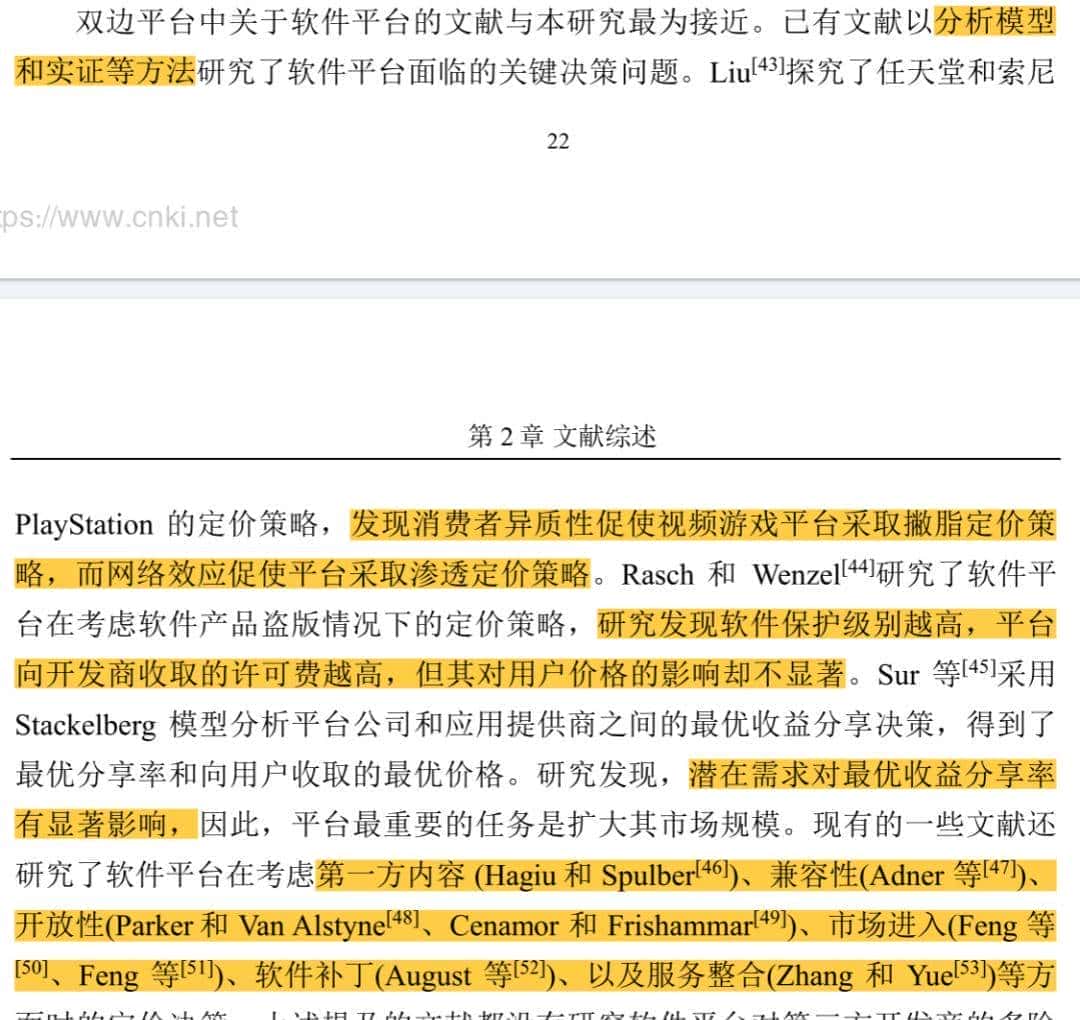
撇脂先高后低,渗透先低后高,皆需视口碑、利率、盗版与顾客耐心而定。若当前销量能提升未来需求,价应逐期下调;用户对价敏感或折现率高,宜先撇脂;高价值客缺耐心、低价值客肯等待,也选高价开路。创新需求旺、盗版威胁大,同样先高后低。渗透则助低质品立誉,并榨取低支付意愿剩余,适用市场差异大、消费者对价不敏感、企业折现低、好评易获、策略性强且服务估值低的情境。两类策略现实出现频率相近,各擅胜场。
Skimming involves a high initial price followed by a lower one, while penetration involves a low initial price followed by a higher one. Both strategies depend on reputation, profit margins, piracy, and customer patience. If current sales can boost future demand, prices should be gradually reduced. If users are price-sensitive or have a high discount rate, skimming is advisable. High-value customers lack patience, while low-value customers are willing to wait, so a high initial price is preferable. When innovation demand is high and the threat of piracy is significant, a high initial price followed by a lower one is also appropriate. Penetration helps lower-quality products establish a reputation and extracts surplus from low-paying willingness-to-pay strategies. It is suitable for scenarios with large market differences, low consumer price sensitivity, low corporate discount rates, easy acquisition of positive reviews, strong strategic elements, and low service valuation. Both strategies occur with similar frequency in reality, each with its own advantages.
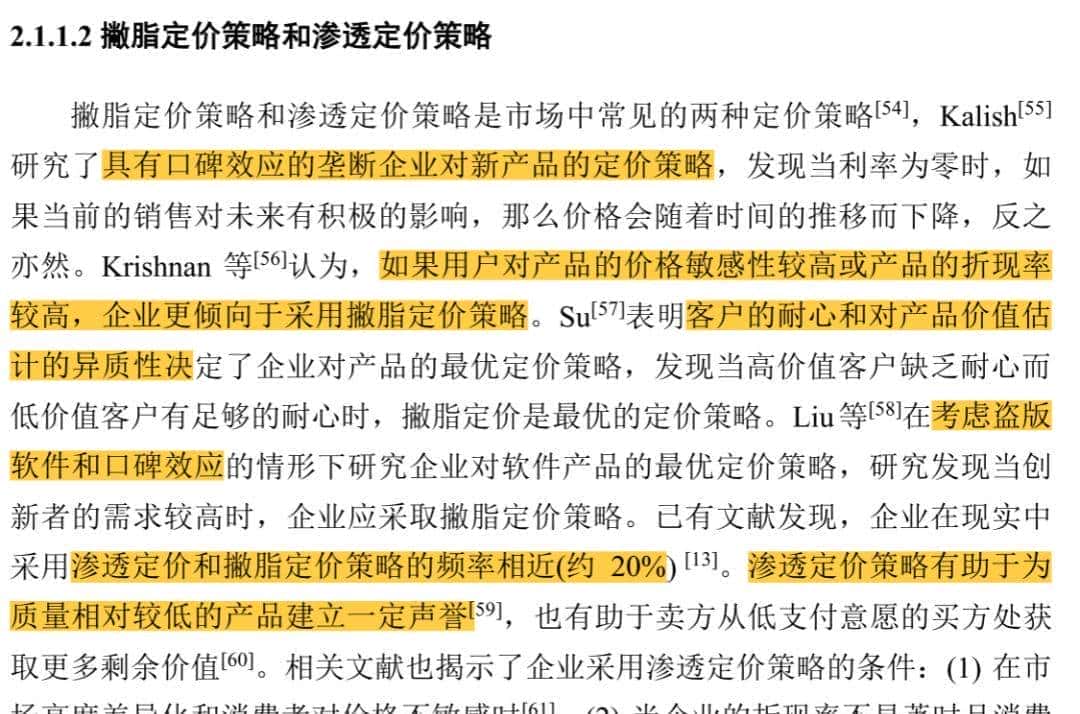
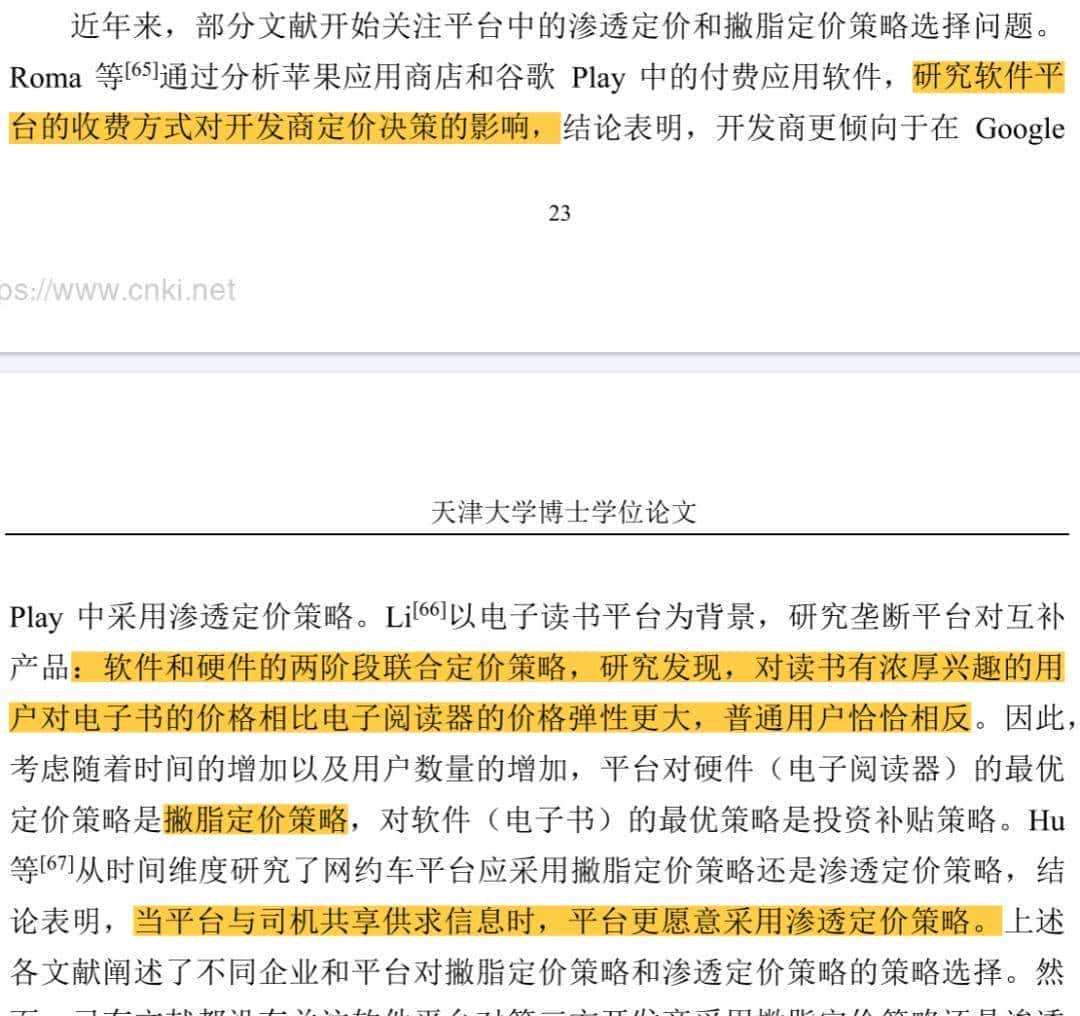
近年研究逐步关注平台自身对撇脂与渗透的选择:苹果与谷歌商店中,开发商更愿在后者用渗透;电子阅读平台对硬件先高后低,对内容补贴;网约车若与司机共享信息,也倾向先低后高。不过,这些讨论多聚焦平台对终端产品或司机的定价,尚未系统考察平台对第三方开发商究竟该先高价还是先低价。鉴此,探讨平台对开发商的多阶段定价策略,厘清何时撇脂何时渗透,可为平台在成长各阶段匹配适宜方案,填补理论空白并指导实践。
Recent research has increasingly focused on platforms' choices regarding skimming versus penetration: in the Apple and Google Play stores, developers prefer penetration on the latter; e-reading platforms initially offer high prices for hardware and then lower prices for content; ride-hailing services, if sharing information with drivers, also tend to start with low prices and then increase them. However, these discussions mostly focus on the pricing platforms offer for end products or drivers, and have not systematically examined whether platforms should initially offer high or low prices to third-party developers. Therefore, exploring platforms' multi-stage pricing strategies for developers, clarifying when to skim and when to penetrate, can fill theoretical gaps and guide practice by matching appropriate solutions for platforms at each stage of growth.
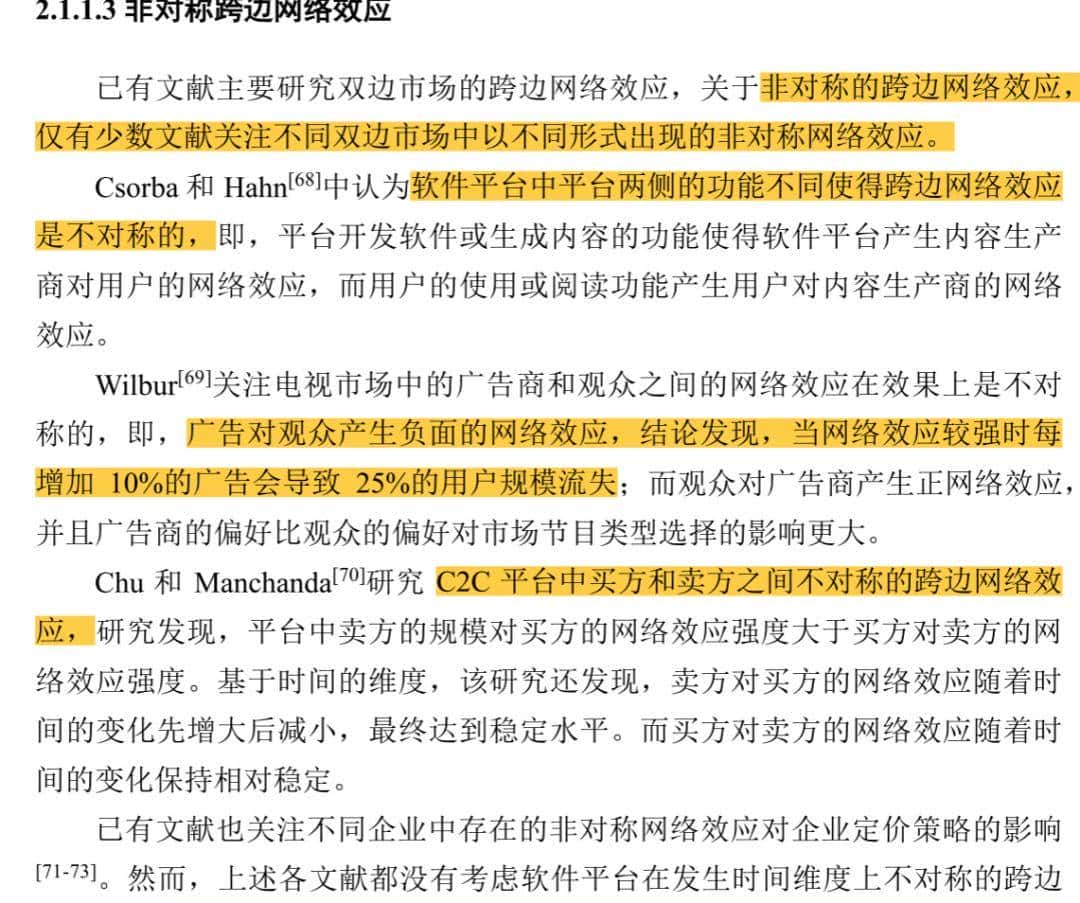
3.非对称跨边网络效应(Asymmetric Cross-Side Network Effects)
少数文献注意到跨边网络效应常呈非对称:软件平台里,开发商先供内容,用户后使用,前者对后者的吸引与后者对前者的反馈强度不同;电视市场中,广告伤观众却利广告主,且广告主偏好更左右节目类型;零售平台里,卖方规模对买方的拉力大于反向作用,并随时间先升后稳,而买方对卖方的影响较平稳。不过,这些研究多假设两边同时入场,未涉开发商先行的时间差。本文正是针对开发商先于用户加入的现实,探讨这一时序不对称如何塑造平台对第三方的定价策略,以补空白。
A few studies have noted that cross-side network effects are often asymmetric: in software platforms, developers provide content first, and users use it later; the former's attraction to the latter differs from the latter's feedback strength to the former. In the television market, advertising harms viewers but benefits advertisers, and advertiser preferences have a greater influence on program type. In retail platforms, the seller's size has a greater pull on the buyer than the reverse, and this pull initially increases and then stabilizes over time, while the buyer's influence on the seller is relatively stable. However, these studies mostly assume that both sides enter the market simultaneously, neglecting the time lag of developers entering first. This paper addresses the reality that developers join before users, exploring how this temporal asymmetry shapes the platform's pricing strategy for third parties, thus filling this gap.
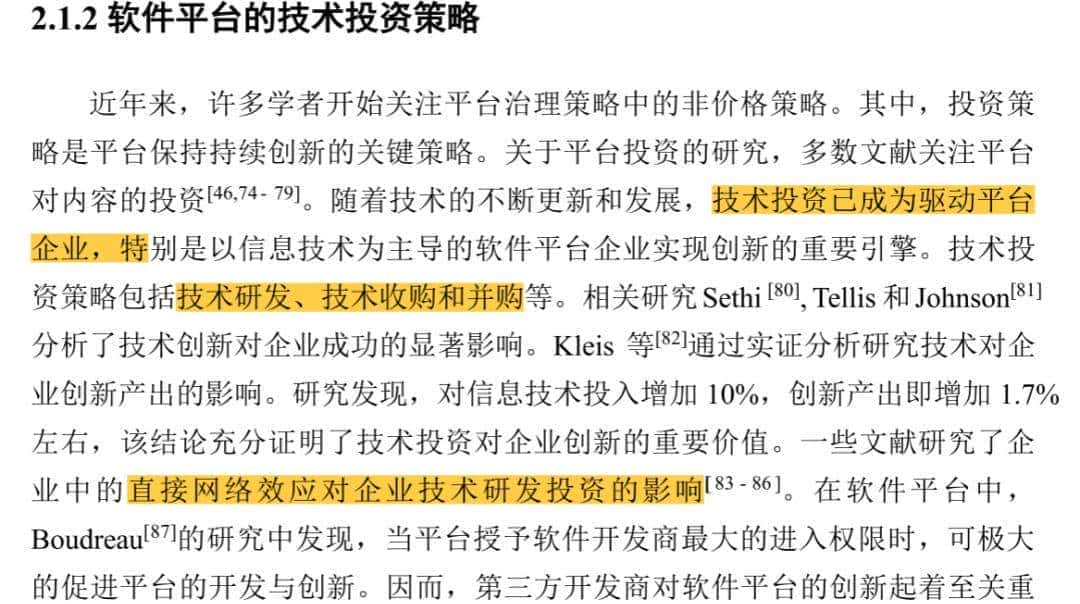
(2)软件平台的技术投资策略(Technology Investment Strategies for Software Platforms)
近年学者将视角从内容经费转向技术投入,视其为平台持续创新引擎。实证显示,信息技术投入每增一成,创新产出约升一点七成,足见其重大。部分研究关注直接网络效应对研发激励的作用,发现开放准入可显著促进创新,第三方开发商更成为关键驱动力。本文将在此基础上,探讨垄断与竞争情境下软件平台的技术投资策略及其跟进性决策,以补现有空白。
In recent years, scholars have shifted their focus from content funding to technology investment, viewing it as the engine for continuous platform innovation. Empirical evidence shows that for every 10% increase in IT investment, innovation output rises by approximately 170%, demonstrating its importance. Some studies focus on the role of direct network effects in R&D incentives, finding that open access can significantly promote innovation, with third-party developers becoming a key driving force. Building on this, this paper will explore the technology investment strategies and follow-up decisions of software platforms under monopolistic and competitive scenarios to fill existing gaps.
1.垄断市场技术投资(Technology Investment in Monopolistic Markets)
垄断平台技术投资研究呈现多维度特征:性能投入过高可能因开发商成本增加而降低参与意愿,需平衡技术导向与服务导向策略;增值服务投资应遵循边际成本阈值原则,在有利预期下通过性能提升吸引用户,不利预期时采用补贴开发商或用户引流策略;物联网基础设施投资显示零售模式更具技术优势,但过度投入可能损害利润。现有研究缺口在于忽视平台技术投资与竞争环境下开发商技术采纳、产品增值及定价策略的互动效应。本研究创新点在于:一是聚焦平台技术工具的价值创造功能而非单纯的成本降低效应,二是引入开发商竞争机制分析技术采纳决策,三是系统研究平台技术投资水平与开发商定价策略的相互影响关系。
Research on technology investment in monopolistic platforms exhibits multi-dimensional characteristics: excessive performance investment may reduce developers' willingness to participate due to increased costs, necessitating a balance between technology-oriented and service-oriented strategies; value-added service investment should follow the marginal cost threshold principle, attracting users through performance improvements under favorable expectations, and employing strategies such as subsidizing developers or attracting users when expectations are unfavorable; IoT infrastructure investment shows that retail models have a greater technological advantage, but excessive investment may damage profits. Existing research gaps lie in neglecting the interactive effects of platform technology investment with developers' technology adoption, product value-added, and pricing strategies in a competitive environment. The innovations of this study are: first, focusing on the value creation function of platform technology tools rather than simply the cost reduction effect; second, introducing a developer competition mechanism to analyze technology adoption decisions; and third, systematically studying the mutual influence between platform technology investment levels and developers' pricing strategies.


2.竞争市场技术投资(Technology Investment in Competitive Markets)
竞争市场技术投资研究显示:合作与否、技术差距大小均显著影响平台研发投入意愿,微小差异亦能放大市场剧变;对平台、用户、开发商的多元补贴可协同激励创新;思考技术失败风险,竞争激烈反而提升高风险项目回报预期,促使企业更敢投资;硬件与内容失配成本的对比则决定性能投资效率与商业模式选择。不过,现有模型普遍假设竞争对手同时决策,忽略现实常见的先后投资顺序。本研究突破这一局限,针对先行平台已完成新技术投入的场景,探讨后行平台的跟进投资时机、力度与策略选择,以揭示顺序投资下的技术竞争规律。
Research on technology investment in competitive markets shows that cooperation and the size of the technological gap significantly influence a platform's willingness to invest in R&D; even small differences can amplify market shifts. Diverse subsidies for platforms, users, and developers can synergistically incentivize innovation. Considering the risk of technological failure, intense competition actually increases the expected returns on high-risk projects, encouraging companies to invest more. The comparison of hardware and content mismatch costs determines the efficiency of performance investment and the choice of business model. However, existing models generally assume that competitors make decisions simultaneously, ignoring the common sequential investment order in reality. This study breaks through this limitation, focusing on scenarios where established platforms have already completed their new technology investments, exploring the timing, intensity, and strategy choices for follow-up investments by later platforms to reveal the patterns of technological competition under sequential investment.

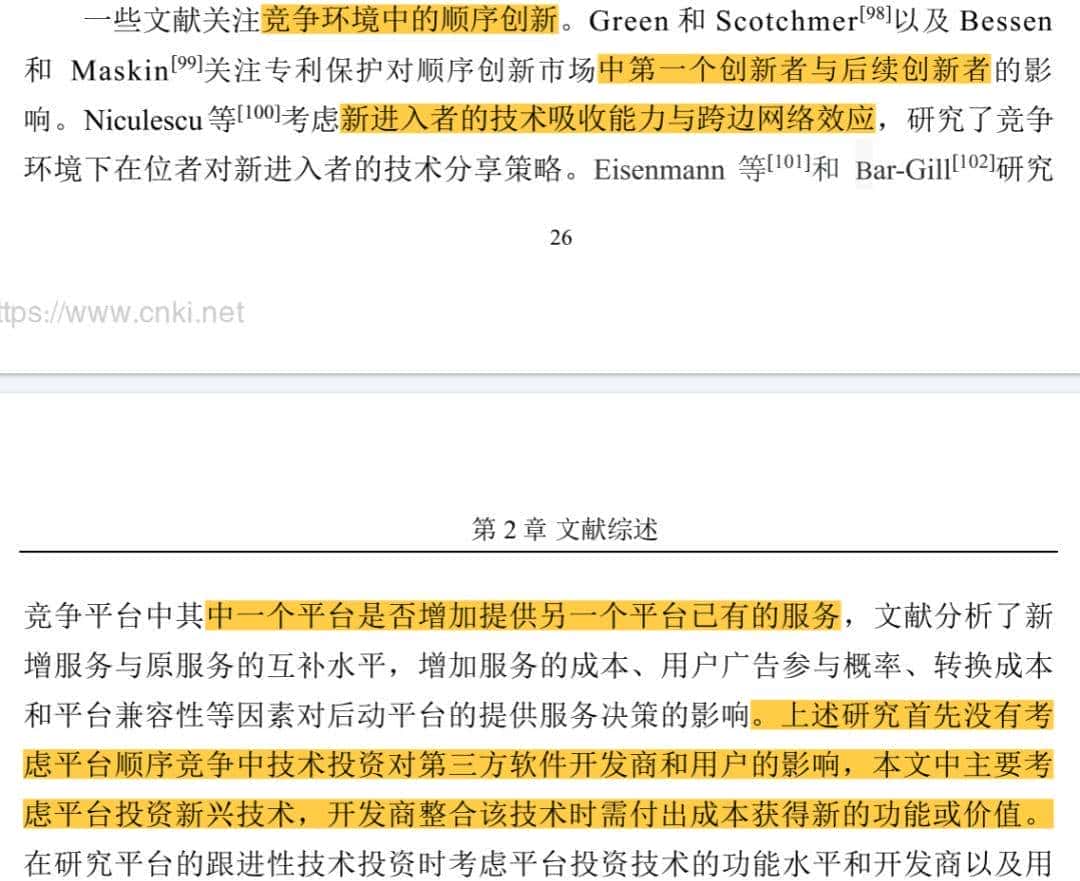
既有顺序创新文献多聚焦专利保护,技术分享,增添服务与转换成本,却忽略平台技术投资对第三方开发商和用户的影响,也未纳入跨边网络效应。本文研究新兴技术投入后,开发商需付成本整合新功能,平台功能水平与双方互动共同决定跟进投资,并考察跨边网络效应如何塑造后续策略。
Existing literature on sequential innovation often focuses on patent protection, technology sharing, and the costs of adding services and switching, but neglects the impact of platform technology investment on third-party developers and users, and also fails to incorporate cross-side network effects. This paper studies how, after the investment in emerging technologies, developers incur costs to integrate new functions, how the platform's functional level and the interaction between the two parties jointly determine follow-up investments, and examines how cross-side network effects shape subsequent strategies.
三、知识补充(Knowledge supplement)
跨边网络效应是多边平台市场最核心的经济特征之一,指的是一侧用户规模的变化会通过平台的交互结构影响另一侧用户的效用或价值。与传统市场不同,在多边体系中,用户并不直接从自身数量中获益,而是从另一侧用户的增长中获得更大的使用价值。因此,平台的价值创造是通过“各侧用户之间的相互吸引”实现的,而不是单纯依赖单侧规模。
Cross-side network effects are one of the core economic characteristics of multilateral platform markets. They refer to how changes in the user base on one side affect the utility or value of users on the other side through the platform's interaction structure. Unlike traditional markets, in a multilateral system, users do not directly benefit from their own numbers, but rather gain greater use value from the growth of users on the other side. Therefore, the platform's value creation is achieved through “mutual attraction between users on each side,” rather than simply relying on the size of one side.
跨边网络效应的本质来源于匹配价值提升、交易效率提高以及不同群体之间的互补性。某一侧的用户越多,平台能够提供的资源、内容或交易机会越丰富,从而使另一侧用户的搜索成本降低、可选择空间扩大、服务质量提升。这类正向反馈往往推动平台形成规模外部性,进一步强化增长动力。
The essence of cross-side network effects stems from the enhancement of matching value, improved transaction efficiency, and complementarity between different groups. The more users on one side, the richer the resources, content, or transaction opportunities the platform can provide, thereby reducing search costs, expanding choices, and improving service quality for users on the other side. This positive feedback often drives the platform to form scale externalities, further strengthening its growth momentum.
在平台运作过程中,跨边网络效应既可能是正向的,也可能是负向的。正向跨边外部性意味着一侧用户增加会提高另一侧用户的效用,例如电商平台上更多商家提升消费者的选择度。但也可能出现负向跨边效应,如广告平台上更多广告主会造成用户体验下降,从而削弱用户对平台的价值感知。平台在治理时必须平衡不同侧之间的激励,使外部性保持在最优区间。
In the process of platform operation, cross-side network effects can be either positive or negative. Positive cross-side externalities mean that an increase in users on one side increases the utility of users on the other side; for example, more merchants on an e-commerce platform increase consumer choice. However, negative cross-side effects can also occur. For example, more advertisers on an advertising platform can lead to a decline in user experience, thereby weakening users' perceived value of the platform. Platforms must balance incentives between different sides during governance to keep externalities within an optimal range.
跨边网络效应与同边网络效应具有显著区别。同边效应强调同类型用户之间的直接影响,如社交平台中用户数量越多社交价值越高;而跨边效应强调不同类型用户的互补关系。例如网约车平台中乘客增加提高司机收入,而司机增加又缩短乘客等待时间,形成典型的双向正跨边效应。
Cross-side network effects differ significantly from same-side network effects. Same-side effects emphasize the direct impact between users of the same type, such as the higher the social value of a social platform with more users; while cross-side effects emphasize the complementary relationship between different types of users. For example, in ride-hailing platforms, an increase in passengers increases driver income, while an increase in drivers reduces passenger waiting time, forming a typical two-way positive cross-side effect.
在实践中,跨边网络效应会带来一系列重大的经济后果,其中最典型的是单边补贴策略。平台常通过向某一侧用户补贴(如免费使用、给开发者分成、补贴司机)来激活另一侧用户的加入,最终依赖被吸引的一侧实现商业化。这种“补贴—吸引—变现”的机制是多边平台成功的核心逻辑。
In practice, cross-side network effects bring a series of important economic consequences, the most typical of which is the unilateral subsidy strategy. Platforms often activate users on the other side by subsidizing users on one side (such as free use, revenue sharing with developers, or driver subsidies), ultimately relying on the attracted side to achieve monetization. This “subsidy-attraction-monetization” mechanism is the core logic of the success of multilateral platforms.
在AI生态、应用商店、内容平台、网约车、电商等典型多边市场中,跨边网络效应构成平台竞争优势与市场结构形成的关键。它解释了为何市场往往向少数平台聚焦、为何早期规模积累至关重大,也为平台定价、治理和扩张策略提供理论基础。
In typical multilateral markets such as AI ecosystems, app stores, content platforms, ride-hailing, and e-commerce, cross-side network effects constitute the key to platform competitive advantage and market structure formation. This explains why markets often concentrate on a few platforms, why early scale accumulation is crucial, and provides a theoretical basis for platform pricing, governance, and expansion strategies.
今天的分享就到这里了。
如果您对文章有独特的想法,
欢迎给我们留言,让我们相约明天。
祝您今天过得开心快乐!
That's all for today's sharing.
If you have a unique idea about the article,
please leave us a message,
and let us meet tomorrow.
I wish you a nice day!
翻译:谷歌翻译
参考资料:谷歌、Chat GPT
参考文献:苑楠. 软件平台系统的治理策略与第三方开发商的接入决策研究 [D]. 天津大学, 2022.
本文由LearningYard学苑整理发出,如有侵权请在后台留言!
文案|hzy
排版|hzy
审核|yyz
© 版权声明
文章版权归作者所有,未经允许请勿转载。
相关文章


暂无评论...