
Map概述
map本质上是一种映射,其可以将任何基本类型(包括STD容器)映射到任何基本类型(包括STL容器)。本质上数组也是一种映射,只不过是一种局限性更大的映射,只能将int类型映射到其它类型,并且由于数组的连续性,当key的分布过于稀疏的时候,会造成大量的空间浪费。要使用map需要#include <map>并加上 using namespace std;
Map的使用
一、Map的定义、元素添加与访问
#include <iostream>
#include <map>

using namespace std;

int main() {

    map<char, int> m; //定义map

    m[ a ] = 1; // 直接用下标添加元素
    m.insert(pair<char, int>( b , 2));  // 用insert函数添加元素
    m[ c ] = 3;


    // 用迭代器访问元素
    map<char, int>::iterator it;
    for (it = m.begin(); it != m.end(); it++) {
        cout << it->first << "," << it->second << endl;
    }

    cout << "----------------------------" << endl;
    // 直接通过下表访问元素
    cout << "a," << m[ a ] << endl;
    cout << "b," << m[ b ] << endl;
    cout << "c," << m[ c ] << endl;

    return 0;
}
运行结果如下:
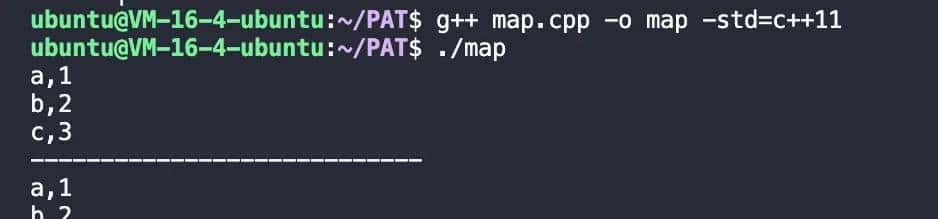
总结:
- map的定义
map<type1, type2> m; - map元素的添加
m[key] = value;m.insert(pair<type1, type2>(key, value));
- map元素的访问
- 定义迭代器(
map<type1, type2>::iterator it;)访问 - 直接用
m[key]访问key对应的value
-
map会以键从小到大的顺序自动排序
将以上程序中元素添加部分改为
m[ c ] = 3;
m[ a ] = 1; // 直接用下标添加元素
m.insert(pair<char, int>( b , 2));  // 用insert函数添加元素
输出的结果不变。因此,map中元素的插入顺序,与map的遍历顺序/map内部元素的排序没有任何关系。之所以会这样,本质上是由于map是用红黑树实现的,红黑树是一种高效的自平衡的二叉树,其会通过旋转和变色来保证平衡,以此来保证内部元素的有序性,方便查找。
二、Map的常用函数
- find
用find函数来查找key,它返回的一个迭代器,当存在(key, value)时,它返回(key, value)所在位置的迭代器,如果map中没有(key, value),则返回的迭代器等于end函数返回的迭代器。
#include <iostream>
#include <map>

using namespace std;

void Find(map<char, int> m, char c) {
    map<char, int>::iterator it;
    it = m.find(c);
    if (it != m.end()) {    // 找到了
        cout << "Find (" << it->first << "," << it->second << ")" << endl;
    } else {
        cout << "No " << c << endl;
    }
}

int main() {

    map<char, int> m; //定义map

    m[ a ] = 1; // 直接用下标添加元素
    m.insert(pair<char, int>( b , 2));  // 用insert函数添加元素
    m[ c ] = 3;

    Find(m,  b );
    Find(m,  d );

    return 0;
}
- erase函数
#include <iostream>
#include <map>

using namespace std;

void Find_Erase(map<char, int> &m, char c) {
    map<char, int>::iterator it;
    it = m.find(c);
    if (it != m.end()) {    // 找到了
        m.erase(it);    // earse函数传递的参数是一个迭代器
    } else {
        cout << "No " << c << endl;
    }
}

int main() {

    map<char, int> m; //定义map

    m[ a ] = 1; // 直接用下标添加元素
    m.insert(pair<char, int>( b , 2));  // 用insert函数添加元素
    m[ c ] = 3;

    for (map<char, int>::iterator iter = m.begin(); iter != m.end(); iter++ ) {
        cout << iter->first << "," << iter->second << endl;
    }

    Find_Erase(m,  b );
    cout << "--------------------" << endl;

    for (map<char, int>::iterator iter = m.begin(); iter != m.end(); iter++ ) {
        cout << iter->first << "," << iter->second << endl;
    }

    return 0;
}
PS: 除了删除单个元素外,erase还可以删除元素区间m.erase(first, last)该区间是一个左闭右开的区间[first, last)
- size函数
m.size()获取map中映射的对数 - clear函数
m.clear()用于清空map中所有的元素
#include <iostream>
#include <map>

using namespace std;

int main() {

    map<char, int> m; //定义map

    m[ a ] = 1; // 直接用下标添加元素
    m.insert(pair<char, int>( b , 2));  // 用insert函数添加元素
    m[ c ] = 3;

    cout << m.size() << endl;
    for (map<char, int>::iterator iter = m.begin(); iter != m.end(); iter++ ) {
        cout << iter->first << "," << iter->second << endl;
    }

    cout << "--------------------" << endl;
    m.clear();

    cout << m.size() << endl;
    for (map<char, int>::iterator iter = m.begin(); iter != m.end(); iter++ ) {
        cout << iter->first << "," << iter->second << endl;
    }

    return 0;
}
三、Map的使用场景
本质上,用到映射的场景可以思考使用map,此外map内元素自动有序也是一大优势。
- 字符串到整数的映射
- 大整数或其它数据类型是否存在的问题,可将map当bool数组使用
拓展:
- key对多个value(允许key重复)得使用multimap
- 处理只映射,不需按key排序的问题,使用unordered_map,效率更高。unordered_map是用哈希表实现的,而map是用红黑树实现的。
© 版权声明
文章版权归作者所有,未经允许请勿转载。
相关文章


暂无评论...