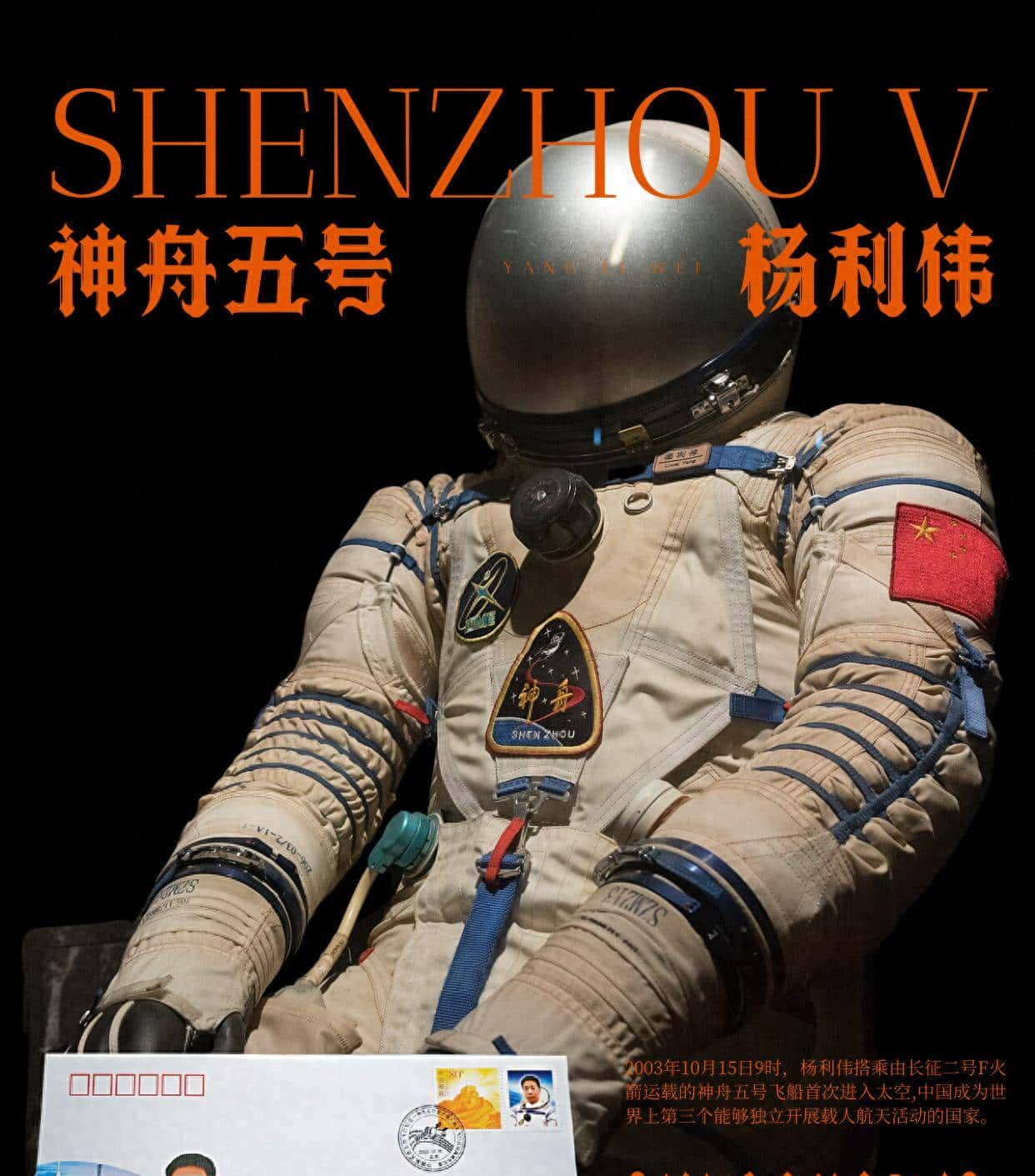
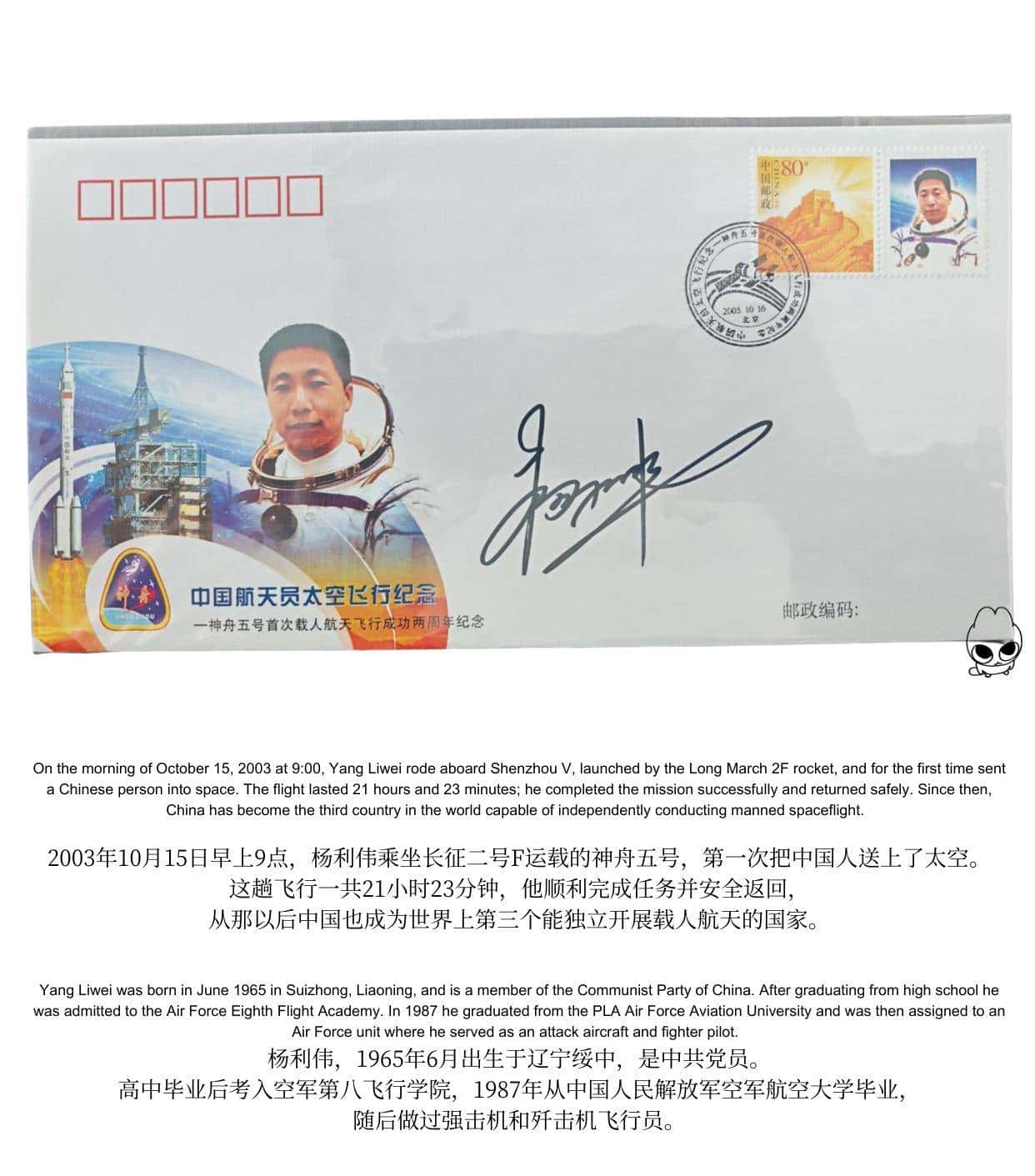
On the morning of October 15, 2003 at 9:00, Yang Liwei rode aboard Shenzhou V, launched by the Long March 2F rocket, and for the first time sent a Chinese person into space. The flight lasted 21 hours and 23 minutes; he completed the mission successfully and returned safely. Since then, China has become the third country in the world capable of independently conducting manned spaceflight.
2003年10月15日早上9点,杨利伟乘坐长征二号F运载的神舟五号,第一次把中国人送上了太空。这趟飞行一共21小时23分钟,他顺利完成任务并安全返回,从那后来中国也成为世界上第三个能独立开展载人航天的国家。
Yang Liwei was born in June 1965 in Suizhong, Liaoning, and is a member of the Communist Party of China. After graduating from high school he was admitted to the Air Force Eighth Flight Academy. In 1987 he graduated from the PLA Air Force Aviation University and was then assigned to an Air Force unit where he served as an attack aircraft and fighter pilot.
杨利伟,1965年6月出生于辽宁绥中,是中共党员。高中毕业后考入空军第八飞行学院,1987年从中国人民解放军空军航空大学毕业,随后做过强击机和歼击机飞行员。
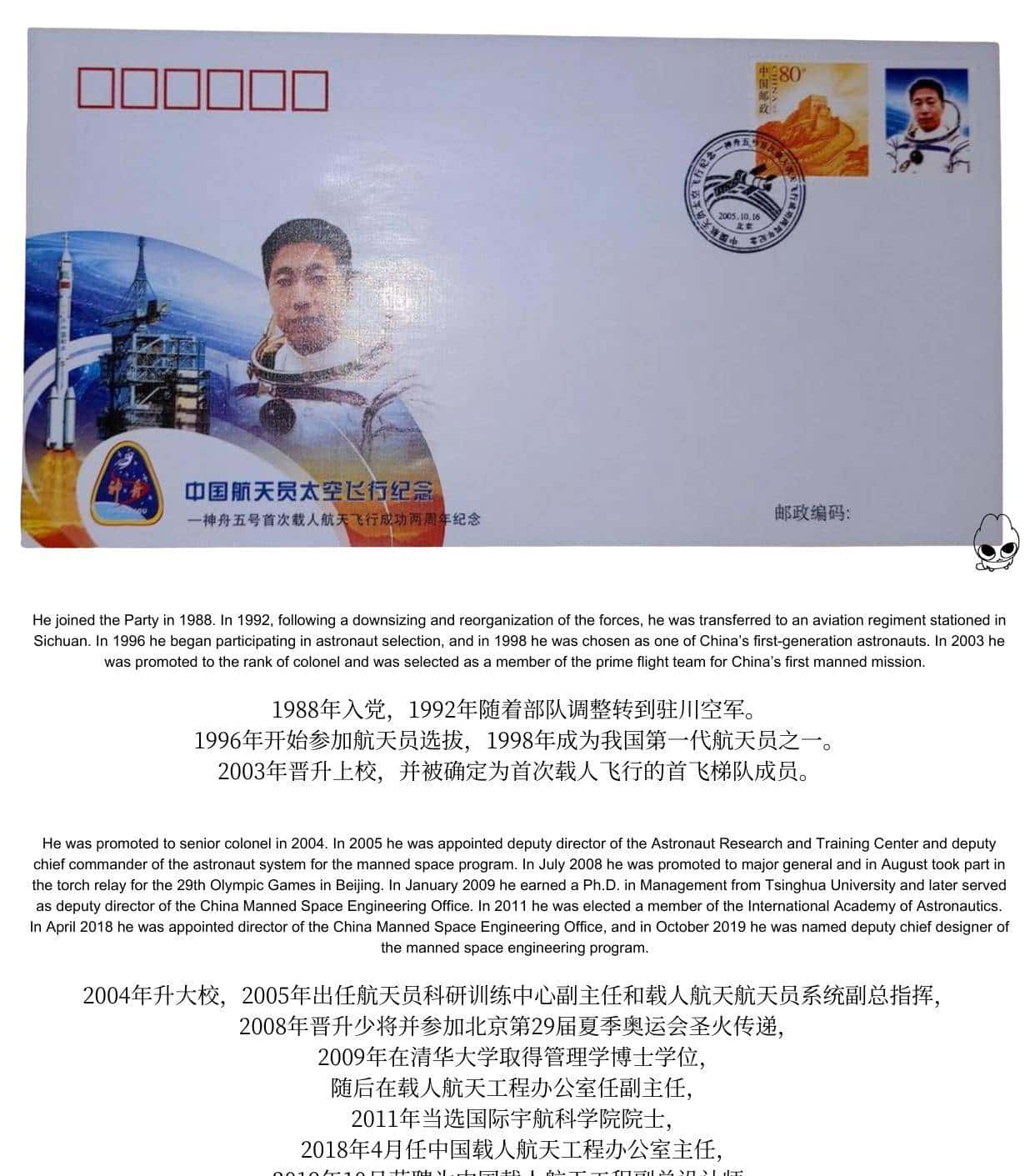
He joined the Party in 1988. In 1992, following a downsizing and reorganization of the forces, he was transferred to an aviation regiment stationed in Sichuan. In 1996 he began participating in astronaut selection, and in 1998 he was chosen as one of China’s first-generation astronauts. In 2003 he was promoted to the rank of colonel and was selected as a member of the prime flight team for China’s first manned mission.
1988年入党,1992年随着部队调整转到驻川空军。1996年开始参与航天员选拔,1998年成为我国第一代航天员之一。2003年晋升上校,并被确定为首次载人飞行的首飞梯队成员。
He was promoted to senior colonel in 2004. In 2005 he was appointed deputy director of the Astronaut Research and Training Center and deputy chief commander of the astronaut system for the manned space program. In July 2008 he was promoted to major general and in August took part in the torch relay for the 29th Olympic Games in Beijing. In January 2009 he earned a Ph.D. in Management from Tsinghua University and later served as deputy director of the China Manned Space Engineering Office. In 2011 he was elected a member of the International Academy of Astronautics. In April 2018 he was appointed director of the China Manned Space Engineering Office, and in October 2019 he was named deputy chief designer of the manned space engineering program.
2004年升大校,2005年出任航天员科研训练中心副主任和载人航天航天员系统副总指挥,2008年晋升少将并参与北京第29届夏季奥运会圣火传递,2009年在清华大学取得管理学博士学位,随后在载人航天工程办公室任副主任,2011年当选国际宇航科学院院士,2018年4月任中国载人航天工程办公室主任,2019年10月获聘为中国载人航天工程副总设计师。
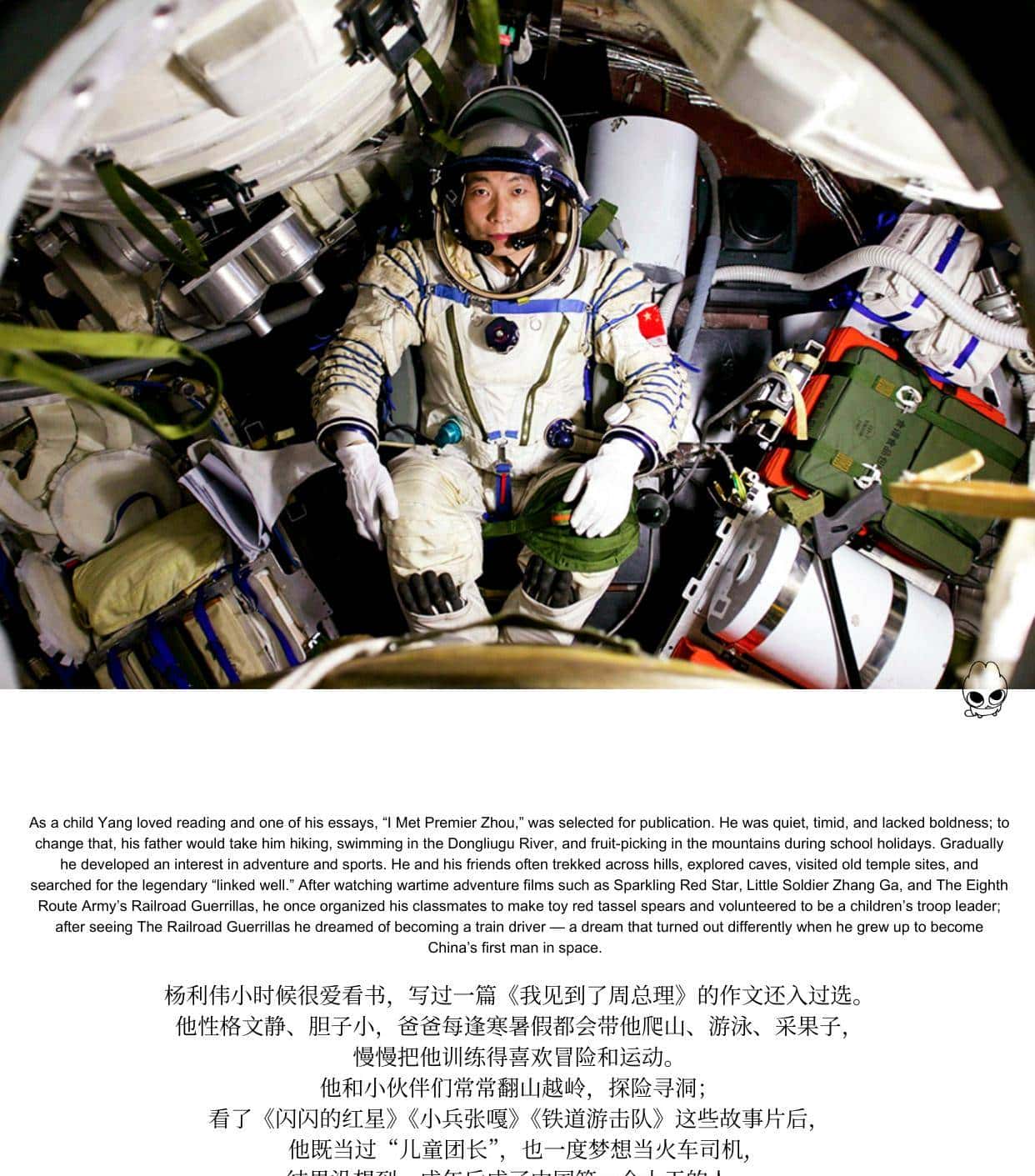
As a child Yang loved reading and one of his essays, “I Met Premier Zhou,” was selected for publication. He was quiet, timid, and lacked boldness; to change that, his father would take him hiking, swimming in the Dongliugu River, and fruit-picking in the mountains during school holidays. Gradually he developed an interest in adventure and sports. He and his friends often trekked across hills, explored caves, visited old temple sites, and searched for the legendary “linked well.” After watching wartime adventure films such as Sparkling Red Star, Little Soldier Zhang Ga, and The Eighth Route Army’s Railroad Guerrillas, he once organized his classmates to make toy red tassel spears and volunteered to be a children’s troop leader; after seeing The Railroad Guerrillas he dreamed of becoming a train driver — a dream that turned out differently when he grew up to become China’s first man in space.
杨利伟小时候很爱看书,写过一篇《我见到了周总理》的作文还入过选。他性格文静、胆子小,爸爸每逢寒暑假都会带他爬山、游泳、采果子,慢慢把他训练得喜爱冒险和运动。他和小伙伴们常常翻山越岭,探险寻洞;看了《闪闪的红星》《小兵张嘎》《铁道游击队》这些故事片后,他既当过“儿童团长”,也一度梦想当火车司机——结果没想到,成年后成了中国第一个上天的人。
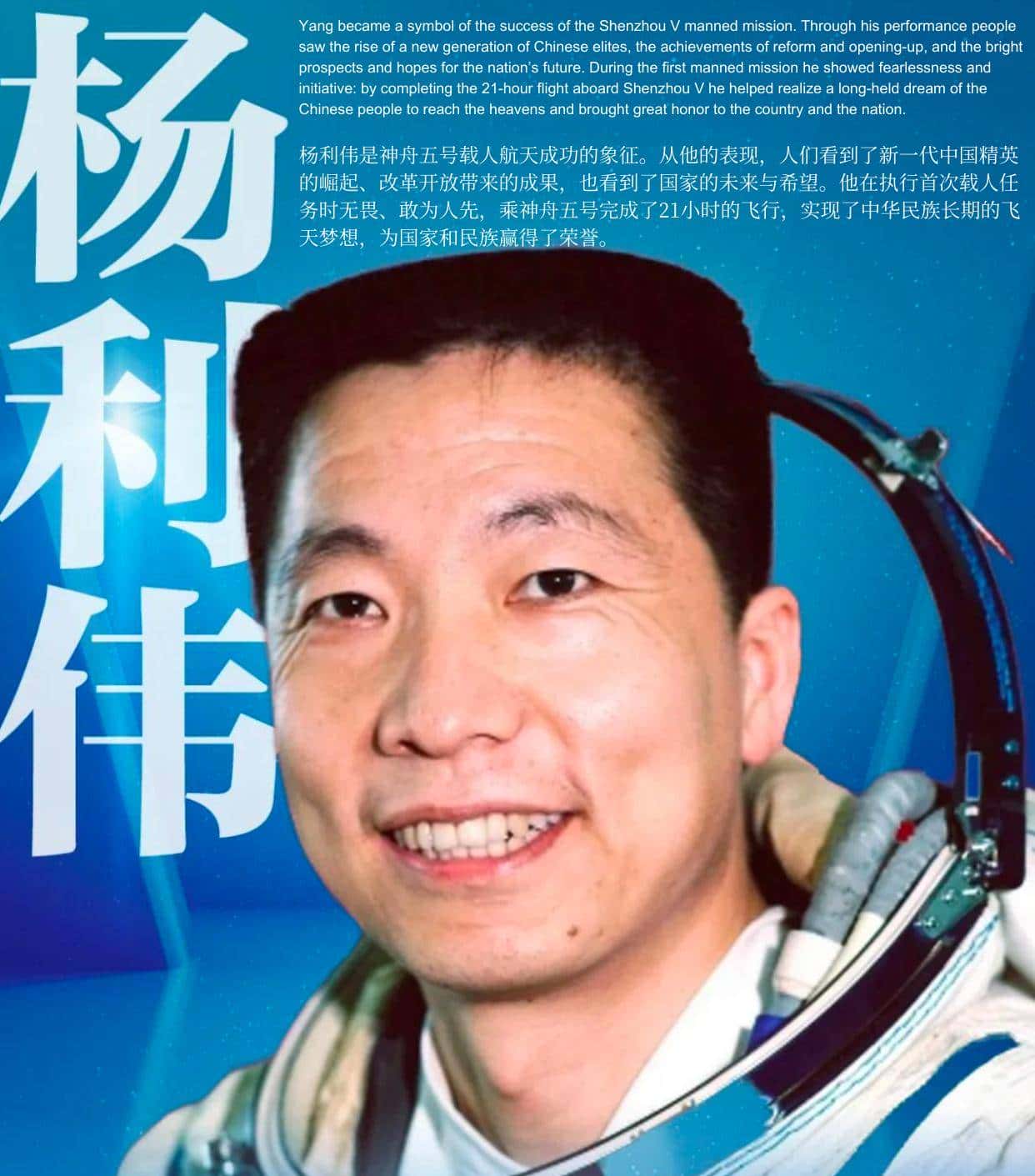
Yang became a symbol of the success of the Shenzhou V manned mission. Through his performance people saw the rise of a new generation of Chinese elites, the achievements of reform and opening-up, and the bright prospects and hopes for the nation’s future. During the first manned mission he showed fearlessness and initiative: by completing the 21-hour flight aboard Shenzhou V he helped realize a long-held dream of the Chinese people to reach the heavens and brought great honor to the country and the nation.
杨利伟是神舟五号载人航天成功的象征。从他的表现,人们看到了新一代中国精英的崛起、改革开放带来的成果,也看到了国家的未来与希望。他在执行首次载人任务时无畏、敢为人先,乘神舟五号完成了21小时的飞行,实现了中华民族长期的飞天梦想,为国家和民族赢得了荣誉。
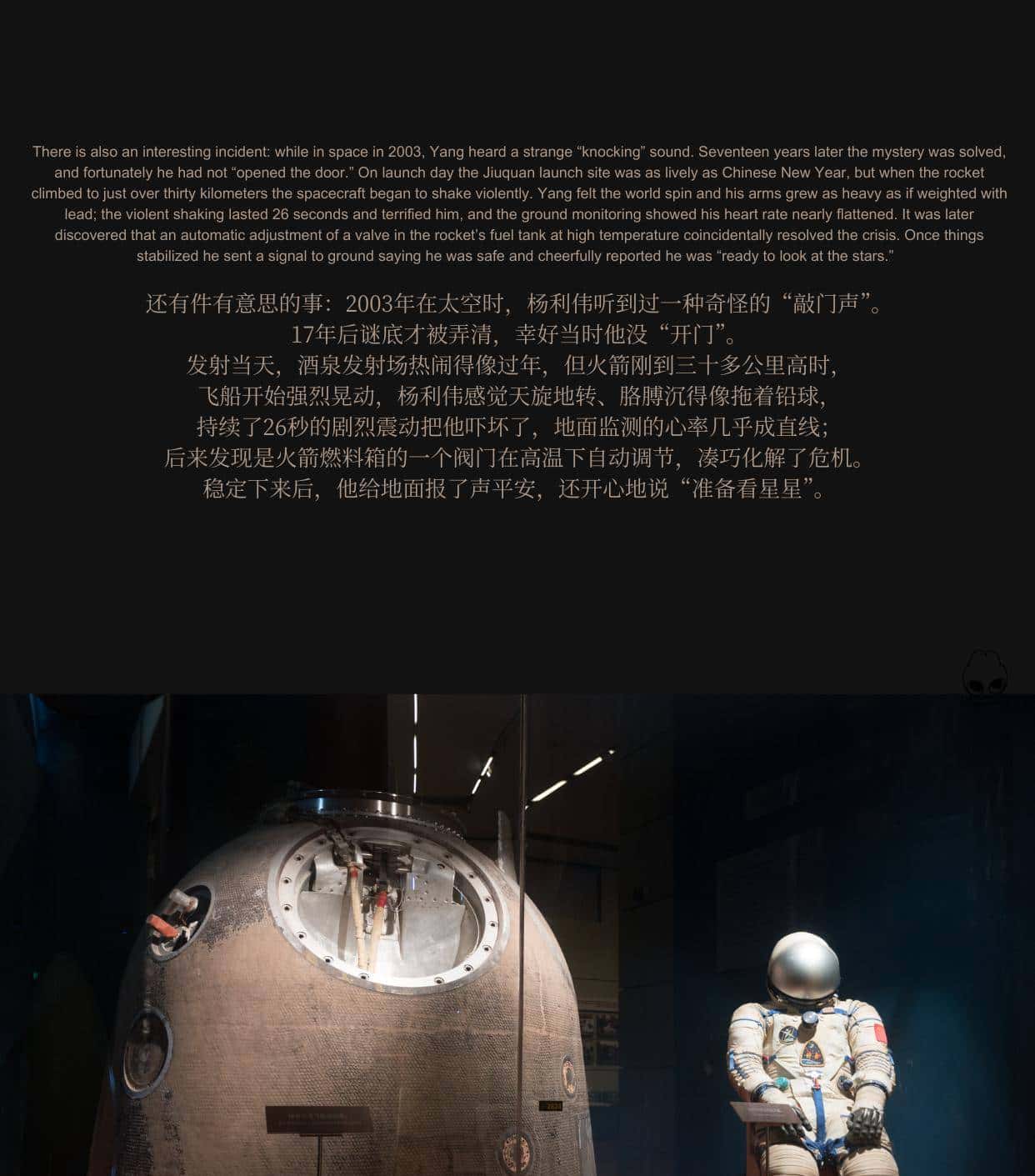
There is also an interesting incident: while in space in 2003, Yang heard a strange “knocking” sound. Seventeen years later the mystery was solved, and fortunately he had not “opened the door.” On launch day the Jiuquan launch site was as lively as Chinese New Year, but when the rocket climbed to just over thirty kilometers the spacecraft began to shake violently. Yang felt the world spin and his arms grew as heavy as if weighted with lead; the violent shaking lasted 26 seconds and terrified him, and the ground monitoring showed his heart rate nearly flattened. It was later discovered that an automatic adjustment of a valve in the rocket’s fuel tank at high temperature coincidentally resolved the crisis. Once things stabilized he sent a signal to ground saying he was safe and cheerfully reported he was “ready to look at the stars.”
还有件有意思的事:2003年在太空时,杨利伟听到过一种奇怪的“敲门声”。17年后谜底才被弄清,幸好当时他没“开门”。发射当天,酒泉发射场热闹得像过年,但火箭刚到三十多公里高时,飞船开始强烈晃动,杨利伟感觉天旋地转、胳膊沉得像拖着铅球,持续了26秒的剧烈震动把他吓坏了,地面监测的心率几乎成直线;后来发现是火箭燃料箱的一个阀门在高温下自动调节,凑巧化解了危机。稳定下来后,他给地面报了声平安,还开心地说“准备看星星”。
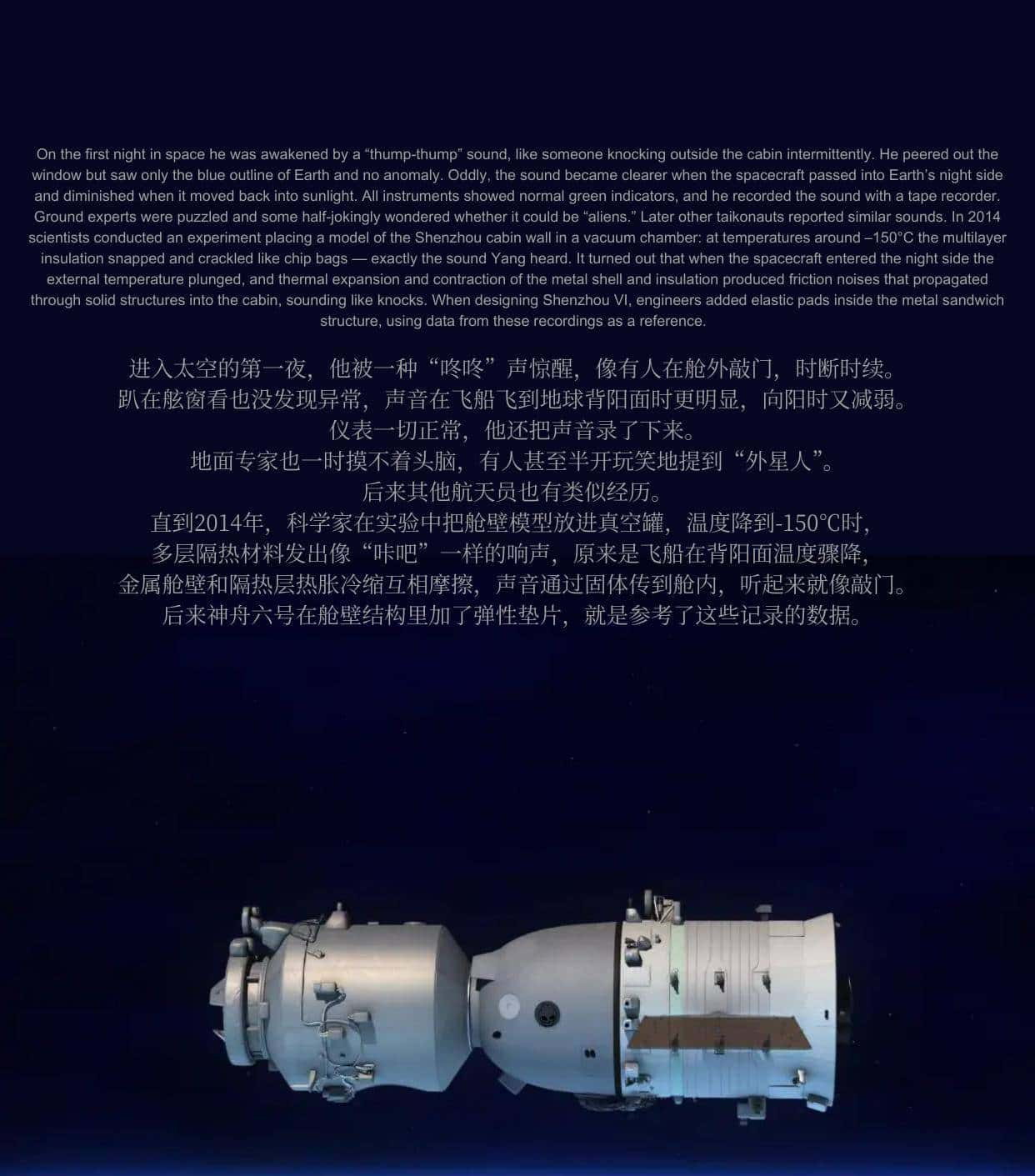
On the first night in space he was awakened by a “thump-thump” sound, like someone knocking outside the cabin intermittently. He peered out the window but saw only the blue outline of Earth and no anomaly. Oddly, the sound became clearer when the spacecraft passed into Earth’s night side and diminished when it moved back into sunlight. All instruments showed normal green indicators, and he recorded the sound with a tape recorder. Ground experts were puzzled and some half-jokingly wondered whether it could be “aliens.” Later other taikonauts reported similar sounds. In 2014 scientists conducted an experiment placing a model of the Shenzhou cabin wall in a vacuum chamber: at temperatures around –150°C the multilayer insulation snapped and crackled like chip bags — exactly the sound Yang heard. It turned out that when the spacecraft entered the night side the external temperature plunged, and thermal expansion and contraction of the metal shell and insulation produced friction noises that propagated through solid structures into the cabin, sounding like knocks. When designing Shenzhou VI, engineers added elastic pads inside the metal sandwich structure, using data from these recordings as a reference.
进入太空的第一夜,他被一种“咚咚”声惊醒,像有人在舱外敲门,时断时续。趴在舷窗看也没发现异常,声音在飞船飞到地球背阳面时更明显,向阳时又减弱。仪表一切正常,他还把声音录了下来。地面专家也一时摸不着头脑,有人甚至半开玩笑地提到“外星人”。后来其他航天员也有类似经历。直到2014年,科学家在实验中把舱壁模型放进真空罐,温度降到-150℃时,多层隔热材料发出像“咔吧”一样的响声,原来是飞船在背阳面温度骤降,金属舱壁和隔热层热胀冷缩相互摩擦,声音通过固体传到舱内,听起来就像敲门。后来神舟六号在舱壁结构里加了弹性垫片,就是参考了这些记录的数据。
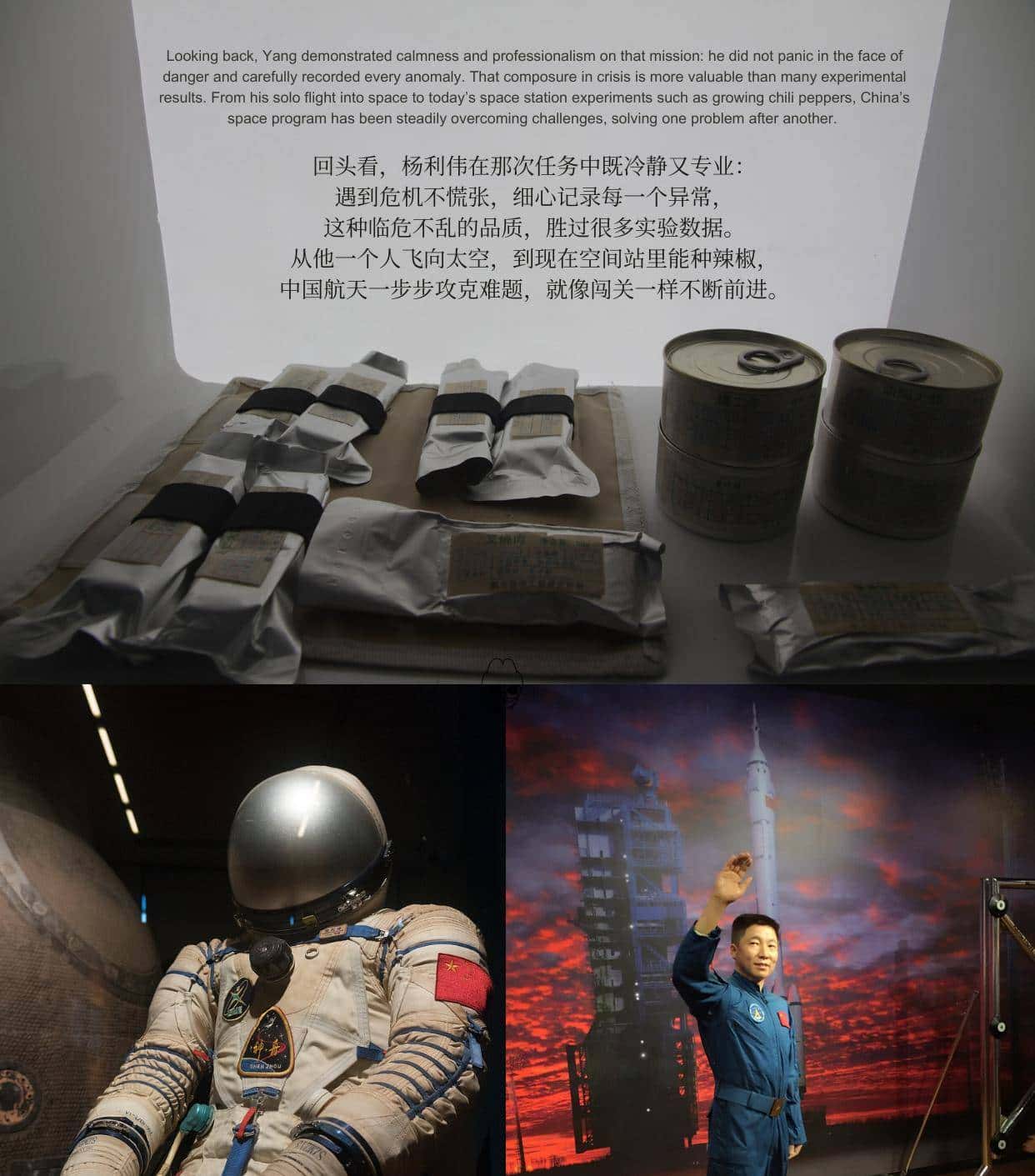
Looking back, Yang demonstrated calmness and professionalism on that mission: he did not panic in the face of danger and carefully recorded every anomaly. That composure in crisis is more valuable than many experimental results. From his solo flight into space to today’s space station experiments such as growing chili peppers, China’s space program has been steadily overcoming challenges, solving one problem after another.
回头看,杨利伟在那次任务中既冷静又专业:遇到危机不慌张,细心记录每一个异常,这种临危不乱的品质,胜过许多实验数据。从他一个人飞向太空,到目前空间站里能种辣椒,中国航天一步步攻克难题,就像闯关一样不断前进。
© 版权声明
文章版权归作者所有,未经允许请勿转载。
相关文章





暂无评论...