limin,lim=threshold,表明“门槛,限制”
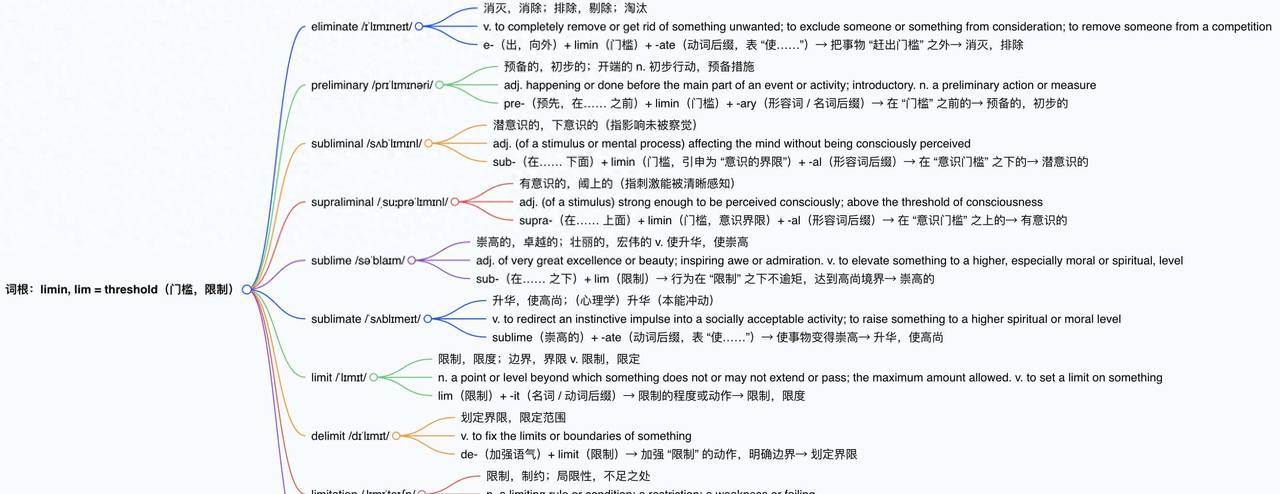
- eliminate /ɪˈlɪmɪneɪt/
中文释义: 消灭,消除;排除,剔除;淘汰。
英文释义: v. to completely remove or get rid of something unwanted; to exclude someone or something from consideration; to remove someone from a competition.
构词: e-(出,向外)+ limin(门槛)+ -ate(动词后缀,表 “使……”)→ 把事物 “赶出门槛” 之外→ 消灭,排除。
例句: The new drug can help eliminate bacteria in the body.(这种新药能协助清除体内的细菌。)/ She was eliminated from the contest in the first round.(她在比赛第一轮就被淘汰了。) - preliminary /prɪˈlɪmɪnəri/
中文释义: 预备的,初步的;开端的 n. 初步行动,预备措施。
英文释义: adj. happening or done before the main part of an event or activity; introductory. n. a preliminary action or measure.
构词: pre-(预先,在…… 之前)+ limin(门槛)+ -ary(形容词 / 名词后缀)→ 在 “门槛” 之前的→ 预备的,初步的。
例句: We need to do some preliminary research before the formal experiment.(正式实验前,我们需要做一些初步研究。)/ The team held a preliminary meeting to discuss the plan.(团队开了一次预备会议讨论计划。) - subliminal /sʌbˈlɪmɪnl/
中文释义: 潜意识的,下意识的(指影响未被察觉)。
英文释义: adj. (of a stimulus or mental process) affecting the mind without being consciously perceived.
构词: sub-(在…… 下面)+ limin(门槛,引申为 “意识的界限”)+ -al(形容词后缀)→ 在 “意识门槛” 之下的→ 潜意识的。
例句: Subliminal advertising is banned in many countries.(潜意识广告在许多国家被禁止。) - supraliminal /ˌsuːprəˈlɪmɪnl/
中文释义: 有意识的,阈上的(指刺激能被清晰感知)。英文释义: adj. (of a stimulus) strong enough to be perceived consciously; above the threshold of consciousness.
构词: supra-(在…… 上面)+ limin(门槛,意识界限)+ -al(形容词后缀)→ 在 “意识门槛” 之上的→ 有意识的。
例句: Supraliminal messages are easier for people to notice and understand.(阈上信息更容易被人们注意和理解。) - sublime /səˈblaɪm/
中文释义: 崇高的,卓越的;壮丽的,宏伟的 v. 使升华,使崇高。
英文释义: adj. of very great excellence or beauty; inspiring awe or admiration. v. to elevate something to a higher, especially moral or spiritual, level.
构词: sub-(在…… 之下)+ lim(限制)→ 行为在 “限制” 之下不逾矩,达到高尚境界→ 崇高的。
q例句: The view from the mountain top is simply sublime.(山顶的景色美得令人赞叹。)/ Her poetry sublimates personal grief into universal themes.(她的诗歌将个人悲痛升华为普世主题。) - sublimate /ˈsʌblɪmeɪt/
中文释义: 升华,使高尚;(心理学)升华(本能冲动)。
英文释义: v. to redirect an instinctive impulse into a socially acceptable activity; to raise something to a higher spiritual or moral level.
构词: sublime(崇高的)+ -ate(动词后缀,表 “使……”)→ 使事物变得崇高→ 升华,使高尚。
例句: He sublimated his love of painting into a career as an art teacher.(他将对绘画的热爱升华为美术教师的职业。) - limit /ˈlɪmɪt/
中文释义: 限制,限度;边界,界限 v. 限制,限定。
英文释义: n. a point or level beyond which something does not or may not extend or pass; the maximum amount allowed. v. to set a limit on something.
构词: lim(限制)+ -it(名词 / 动词后缀)→ 限制的程度或动作→ 限制,限度。
例句: There is a limit to how much money we can spend on this project.(我们在这个项目上的花费有上限。)/ We need to limit our expenses this month.(这个月我们需要限制开支。) - delimit /dɪˈlɪmɪt/
中文释义: 划定界限,限定范围。
英文释义: v. to fix the limits or boundaries of something.
构词: de-(加强语气)+ limit(限制)→ 加强 “限制” 的动作,明确边界→ 划定界限。
例句: The treaty helps to delimit the border between the two countries.(该条约有助于划定两国间的边界。) - limitation /ˌlɪmɪˈteɪʃn/(增补词)
中文释义: 限制,制约;局限性,不足之处。
英文释义: n. a limiting rule or condition; a restriction; a weakness or failing.
构词: limit(限制)+ -ation(名词后缀,表 “动作或状态”)→ 限制的状态或结果→ 限制,局限性。
例句: The main limitation of the study is the small sample size.(这项研究的主要局限性是样本量小。) - unlimited /ʌnˈlɪmɪtɪd/(增补词)
中文释义: 无限的,无限制的;不受约束的。
英文释义: adj. not limited or restricted in number, quantity, or extent; unrestricted.
构词: un-(否定前缀,表 “不”)+ limit(限制)+ -ed(形容词后缀)→ 不受限制的→ 无限的。
例句: The internet offers unlimited access to information.(互联网提供了无限的信息获取渠道。)
特别说明、记忆方法与注意点
一、特别说明
- 词根含义的延伸:
“limin” 核心为 “门槛”,可引申为 “意识的界限”(如 subliminal “潜意识的”、supraliminal “有意识的”);
“lim” 核心为 “限制”,既指 “物理或数量的界限”(如 limit “限度”),也可指 “道德 / 行为的约束”(如 sublime “崇高的”,因遵守约束而高尚),需结合语境理解延伸义。 - 词根变体与构词:
“limin” 和 “lim” 为同源词根,在构词中可根据后缀需求灵活使用(如 limin+ary 构成 preliminary,lim+it 构成 limit);
部分单词通过前缀改变语义方向(如 sub-“在下”、supra-“在上”、e-“出”),需关注前缀与词根的搭配逻辑。 - 专业领域词汇:
“subliminal”“supraliminal” 多用于心理学、传播学领域,“sublimate” 在心理学中特指 “本能冲动的升华”,这些词汇在专业场景外使用频率较低,需注意使用范围。
二、记忆方法
- 词根 + 前缀联动记忆:
通过前缀明确 “门槛 / 限制” 的语义方向,快速推导词义:
表 “空间 / 方向”:e-(出)+ limin → eliminate(赶出门槛→消灭);s
ub-(在下)+ limin → subliminal(在意识门槛下→潜意识的);
表 “时间 / 顺序”:pre-(预先)+ limin → preliminary(在门槛前→初步的);
表 “否定 / 肯定”:un-(不)+ limit → unlimited(无限制的);
supra-(在上)+ limin → supraliminal(在意识门槛上→有意识的)。 - 场景分类记忆:
将单词按 “抽象概念、行为动作、专业术语” 分类,强化关联:
抽象概念:limit(限制)、limitation(局限性)、unlimited(无限的);
行为动作:eliminate(消灭)、delimit(划定界限)、sublimate(升华);
专业术语:subliminal(潜意识的)、supraliminal(阈上的)。 - 反义词对比记忆:
将 “对立含义” 的单词成对记忆,例如 “subliminal(潜意识的)— supraliminal(有意识的)”,“limited(有限的)— unlimited(无限的)”,通过对比加深印象。
三、备注
- 发音细节:
“sublime” 发音为 /səˈblaɪm/(重音在第二音节),易误读为 /ˈsʌblaɪm/;
“eliminate” 发音为 /ɪˈlɪmɪneɪt/,注意 “min” 部分发 /ɪmɪn/,避免漏读音节;
“preliminary” 重音在第二音节 /prɪˈlɪmɪnəri/,不可读成首音节重音。 - 易混淆单词辨析:
“eliminate” vs “delete”:二者均有 “删除” 义,但 “eliminate” 侧重 “彻底清除、消灭(事物 / 人)”(如 eliminate poverty “消除贫困”),“delete” 侧重 “删除文字、数据等”(如 delete a file “删除文件”);
“sublime” vs “noble”:二者均表 “崇高的”,“sublime” 更侧重 “事物的壮丽或精神的超凡”(如 sublime scenery “壮丽景色”),“noble” 更侧重 “人的品格高尚”(如 noble character “高尚品格”)。 - 使用语境限制:
“sublimate” 表 “心理学升华” 时为专业用法,日常描述 “提升境界” 可用 “elevate”“raise” 更自然;
“preliminary” 作名词时多用复数形式 “preliminaries”(如 “the preliminaries of the game” 比赛预赛),单数形式较少使用;
“delimit” 为正式书面语,日常描述 “划界限” 可用 “define the boundaries”,避免用词过于生硬。
© 版权声明
文章版权归作者所有,未经允许请勿转载。
相关文章


暂无评论...